

The scent of freshly sheared cedar hits your lungs before you even pick up the pencil. It is a crisp, resinous perfume that signals the start of something precise. You can feel the vibration of the workshop floor through your boots as the heavy machinery hums in the distance. My hands are itching to touch that raw, porous surface. When you are building for longevity, you cannot just eyeball your progress. You have to be obsessed with the ninety degree angle. Using a Try Square is the only way to ensure your joints do not fail under lateral stress. If your reference line is off by even a fraction of a millimeter, the tensile strength of your entire frame is compromised. We are looking for that perfect, light-tight seal where metal meets wood. This is not just about making a box; it is about the physics of perpendicularity. Every single stroke of your marking knife is a contract you are signing with the material. Let us get into the grit of it.
THE STUDIO KIT
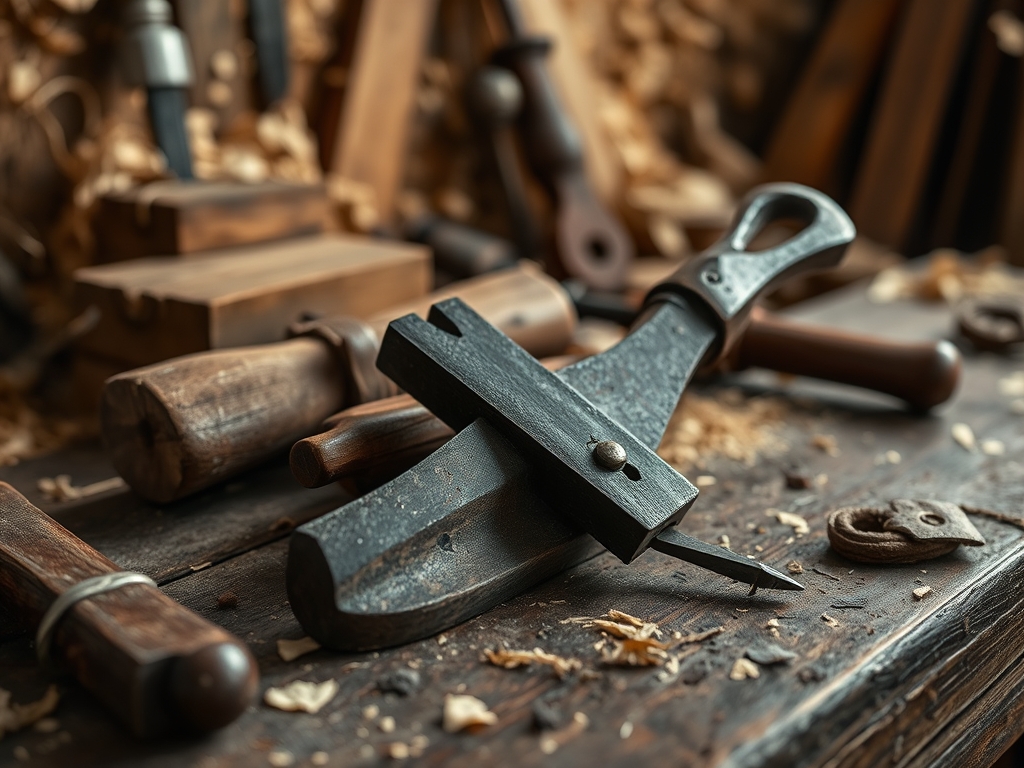
To master the art of the perfect edge, your toolkit needs to be a curated collection of high-precision instruments. At the heart of this operation is the Try Square, preferably one with a hardened steel blade and a heavy brass or rosewood stock. The weight of the stock provides the necessary ergonomic counterbalance when you are pressing it against a workpiece. You will also need a marking awl or a thin-bladed striking knife. Unlike a graphite pencil, a knife severs the wood fibers, creating a physical track for your saw to follow. This prevents "grain wander" during the initial cut.
For measuring thickness and ensuring your stock is uniform, a pair of digital calipers is non-negotiable. You are looking for consistency down to the thousandth of an inch. If you are working with softer materials, keep a bone folder nearby to burnish edges without marring the surface.
Material Substitutions: If you cannot source premium hardwoods like white oak or walnut, high-density Baltic birch ply is a fantastic alternative due to its cross-laminated stability. If a professional try square is out of reach, a machinist's square offers even higher tolerances, though it lacks the lip for easy hanging on a workbench edge.
THE TEMPO
The "Maker's Rhythm" is a specific psychological state where your heart rate slows to match the speed of your tools. For this project, expect to spend about forty minutes in the preparation phase. This involves truing your stock and checking your square for accuracy against a known straight edge. The execution phase, where the actual marking and cutting happen, takes roughly two hours of intense focus. Finally, the refinement phase involves another hour of checking and re-checking every joint.
In total, give yourself a four-hour window. This allows for the "cooling period" where you step away from the bench to let your eyes reset. If you rush the gauge settings or force a cut, you risk thermal expansion or mechanical deformation of the wood fibers, which will ruin your tolerances.
THE CORE METHOD
1. Establish the Face Side and Edge
Before you even think about Using a Try Square, you must identify the flattest face of your material. Use a jointer plane to remove high spots until the surface is perfectly planar. Once the face is flat, plane one edge until it is exactly perpendicular to that face. Mark these with "cabinetmaker's marks" so you always know which surfaces are your reliable data points.
Mastery Tip: The science of structural integrity relies on these reference surfaces. If you reference your square from a non-flat side, the error compounds geometrically as you move around the piece, a phenomenon known as "tolerance stack-up."
2. Seating the Stock
Hold your workpiece firmly. Press the thick stock of the try square against your reference edge. You should feel a distinct "thunk" as the metal meets the wood. Ensure there is no sawdust or debris trapped between the tool and the material, as even a single grain of sand can throw your angle off by several degrees.
Mastery Tip: This relies on frictional stability. By applying consistent pressure toward the reference edge, you prevent the tool from pivoting during the marking process.
3. Striking the Line
Position your marking knife against the blade of the square. Tilt the knife slightly away from the square so the flat back of the blade is flush against the steel. Pull the knife toward you in one smooth, confident motion. Do not saw back and forth. You are looking to create a clean, microscopic canyon in the wood.
Mastery Tip: This technique utilizes capillary action when you later apply finish. A clean knife line prevents stain from bleeding across the grain boundaries, keeping your joinery lines crisp and professional.
4. Checking for Light
Once your line is marked, flip the square over and check it from the opposite direction. If you see even a sliver of light between your marked line and the square's blade, your edge is not true. This is the moment of truth. You must adjust your workpiece until the square sits perfectly flush against the line from both sides.
Mastery Tip: The human eye is incredibly sensitive to parallax error. By checking against a light source, you are using high-contrast visualization to detect gaps as small as 0.001 inches.
THE TECHNICAL LEDGER
Maintenance & Longevity: Your try square is a precision instrument, not a hammer. Store it in a felt-lined drawer or on a dedicated tool wall. Periodically wipe the steel blade with a light coat of camellia oil to prevent oxidation. If the square is dropped, it must be recalibrated immediately using the "five-cut method" or a machinist's block.
Material Variations:
- Sustainable: Reclaimed Douglas fir offers great character but requires frequent tool sharpening due to its high silica content.
- Premium: Quarter-sawn white oak provides maximum dimensional stability and resists warping over time.
- Recycled: High-density polyethylene (HDPE) sheets can be squared using the same methods, though they require slower tool speeds to prevent melting.
The Correction:
- The Gap: If the square does not sit flush, your edge is likely "crowned." Use a block plane to take thin shavings from the center.
- The Wander: If your knife line drifts, your grip is too loose. Use a rotary cutter or a fresh blade to re-establish the track.
- The Burp: If the wood fibers tear, the grain direction is working against you. Reverse your planing direction to follow the "downhill" grain.
Studio Organization: To prevent degradation, keep your project in a climate-controlled environment. Drastic shifts in humidity cause wood to expand and contract at different rates across its ply, which can pull a perfectly square frame out of alignment overnight.
THE FINAL REVEAL
There is nothing quite like the feeling of sliding two perfectly squared components together. When that joint closes with a soft "whoosh" of displaced air, you know you have nailed the physics. The finished piece feels solid, heavy, and intentional. It catches the light in a way that only perfectly perpendicular surfaces can. You have moved past "good enough" and entered the realm of true craftsmanship. Your hands might be tired, but that sense of geometric perfection is a high that lasts forever.
STUDIO QUESTIONS
Why is a marking knife better than a pencil?
A marking knife severs wood fibers to create a physical groove. This provides a precise mechanical track for saws and chisels, whereas a pencil line has a measurable thickness that can lead to gauge inaccuracies.
How do I know if my try square is still accurate?
Draw a line perpendicular to a straight edge, then flip the square over. If the blade aligns perfectly with the line from the opposite side, it is square. Any deviation indicates the tool is out of alignment.
Can I use a try square on metal?
Yes, but you should use a machinist's square for metalwork. The hardened steel of a try square can be scratched by metal burrs, and the tolerances required for metal are often tighter than those for porous wood.
What is the best way to store my squares?
Store them hanging vertically or flat in a dedicated case. Avoid tossing them in a toolbox where they can knock against other steel tools, which can mar the edges and ruin the ergonomic balance.
Does humidity affect my measurements?
Absolutely. Wood is hygroscopic and will expand or contract based on moisture levels. Always check your work with a try square immediately before cutting to account for any overnight shifts in the material's tensile state.