
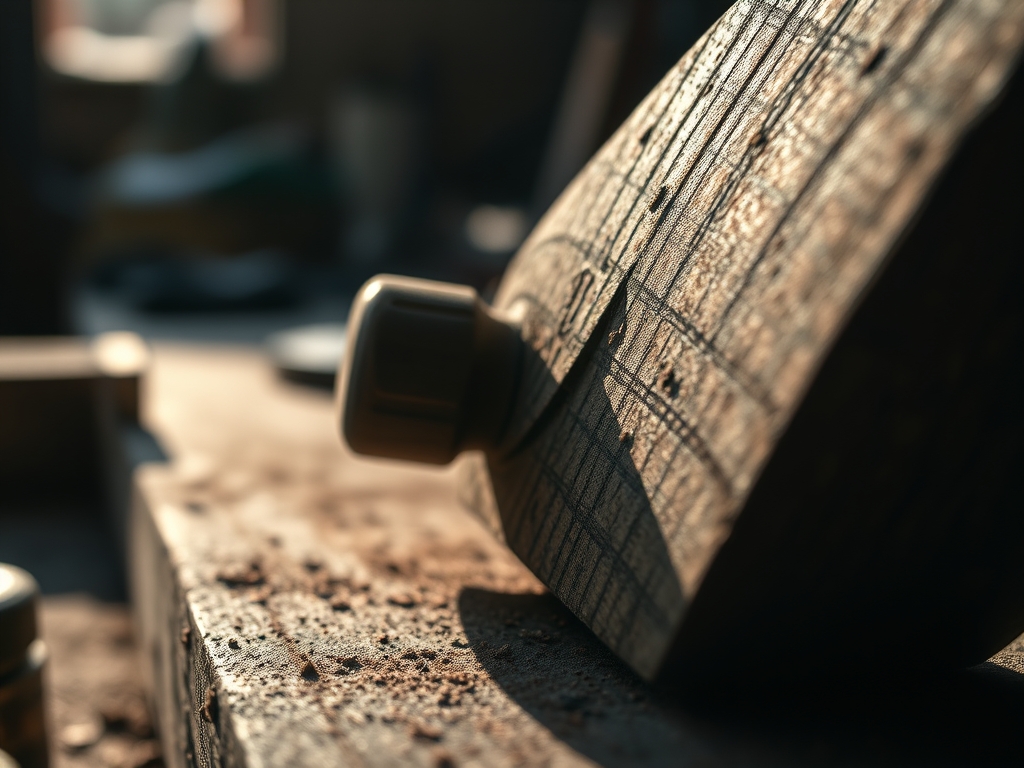
Imagine the smell of raw, kiln dried Douglas fir filling your workshop as you stand before an eighteen foot beam. This is not just wood; it is a structural organism with a complex cellular matrix of cellulose and lignin. To master this beast, you must master the art of Using a Chalk Line to define your geometry across its rugged, porous surface. The snap of the string is the first heartbeat of the project. It is a sharp, percussive crack that translates a mathematical ideal onto a physical plane. When that blue or red dust settles into the wood grain, you have officially bridged the gap between a rough forest product and a precision engineered joint. We are talking about layout work where a sixteenth of an inch determines whether a tenon slides home or stalls out. You feel the weight of the chalk box in your hand; its ergonomic casing is cold, but the potential energy coiled inside the spring is ready to release. We are not just marking wood; we are imposing order on chaos using physics and tension.
THE STUDIO KIT

To execute a professional layout, your kit must be curated for high precision and environmental durability. The centerpiece is a high ratio geared chalk reel. Look for a model with a 6:1 gear ratio to ensure rapid retrieval of the line through the chalk reservoir. The line itself should be a braided micro line rather than a thick twisted cord. Braided lines offer higher tensile strength and produce a thinner, crisper mark that minimizes "ghosting" or bleed. You will also need a high quality marking awl to anchor your line at the starting point. This tool allows you to pierce the wood fibers and create a fixed pivot point that will not shift under tension.
For the chalk, choose your pigment based on the wood species and the weather. Red chalk contains higher levels of iron oxide and is semi permanent; use it only if the marks will be hidden or planed away later. Blue chalk is standard for visibility, while white or fluorescent green works best on charred or dark stained timbers. Material Substitutions are possible in a pinch. If you run out of industrial chalk, powdered carpenter's crayon can be crushed into a fine dust, though it lacks the specialized flow agents found in professional powders. For the layout square, skip the plastic versions and reach for a stainless steel framing square or a precision machined aluminum rafter square to ensure your 90 degree references are absolute.
THE TEMPO
The "Maker's Rhythm" in timber framing is a sequence of high focus bursts followed by steady, meditative execution. The layout phase for a standard bent usually requires a solid four hour block of undisturbed concentration. You spend thirty percent of your time in "The Verification Phase," where you check the crown and twist of the timber using winding sticks. This is followed by "The Snap Phase," which is the fastest but most critical part of the process. Each snap takes mere seconds, but the setup requires minutes of calibration. Finally, you enter "The Scribe Phase," where you use a sharp knife or a 4H pencil to darken the chalk marks into permanent guides. Respecting this tempo prevents the mental fatigue that leads to "cumulative error," where small deviations at the start of a beam grow into massive misalignments by the end.
THE CORE METHOD
1. Establishing the Primary Reference
First, identify the "reference face" and the "adjacent face" of your timber. Use your winding sticks to ensure the beam is not excessively twisted. Once the timber is leveled on your sawhorses, drive your marking awl into the exact center point of your first measurement. Mastery Tip: This utilizes the principle of mechanical anchorage. By seating the awl deep into the latewood of the growth ring, you prevent the string from "creeping" sideways, which would otherwise introduce a parabolic curve into your supposed straight line.
2. Charging the Line
Pull the string out about three feet and shake the reel vigorously. This ensures the line passes through the internal chalk reservoir and achieves maximum saturation. Mastery Tip: This is about surface area and friction. The braided fibers of the line act as tiny hooks that trap the pigment particles. If you pull the line too fast, the friction creates static electricity that can actually repel the chalk dust, leading to a faint or patchy mark.
3. Setting the Tension
Stretch the line to the far end of the timber and hold it firmly against your mark. Pull the string taut until it hums like a guitar string. Mastery Tip: You are managing linear elasticity. A loose line will sag under its own weight, creating a "catenary curve" that ruins your accuracy. You need enough tension to overcome the gravitational pull but not so much that you exceed the elastic limit of the nylon or polyester cord.
4. The Vertical Snap
Reach toward the center of the span, pull the string straight up about two inches, and release it cleanly. Mastery Tip: This relies on percussive displacement. When the string hits the wood, the kinetic energy transfers to the chalk particles, driving them into the tracheids and vessels of the wood grain. Always pull the string perpendicular to the surface. If you pull it at an angle, the line will "roll" upon impact, creating a blurred or wide mark that lacks precision.
5. Scribing for Permanence
Once the chalk line is snapped, immediately go over the line with a sharp marking knife or a fine point lead. Mastery Tip: Chalk is a temporary medium subject to atmospheric degradation and wind. By using a knife, you create a physical "kerf" in the wood fibers. This kerf acts as a microscopic guide for your saw blade later, ensuring that your cut follows the exact path of your mathematical layout.
THE TECHNICAL LEDGER
Maintenance & Longevity: Keep your chalk box dry. If moisture enters the reservoir, the chalk will "clump," preventing even distribution on the line. If your line becomes damp, pull it out to its full length and hang it to dry before retracting it. Periodically replace the line entirely to prevent fraying, which reduces the crispness of your marks.
Material Variations:
- Sustainable: Use biodegradable chalk pigments derived from natural minerals.
- Recycled: Repurpose old fly fishing line for ultra fine layout work on furniture grade timbers.
- Premium: Invest in a stainless steel chalk reel with a sealed gasket to prevent dust leaks in high end studio environments.
The Correction:
- The Double Snap: If you accidentally snap the line twice and get two marks, do not guess. Use a damp cloth to wipe the timber clean, let it dry, and re snap.
- The Shadow Line: If your line is too thick, your chalk is likely too wet or the line is too coarse. Switch to a micro line for a 0.5mm mark.
- The Wind Drift: In outdoor sites, wind can blow the string off course during the snap. Use a "mid point hold" where a partner holds the string down at the center while you snap each half separately.
Studio Organization: Store your layout tools in a dedicated "Precision Chest." Keep the chalk box away from oil or grease, as any lubricant on the string will prevent chalk adhesion. Store timbers on level stickers to prevent "bowing" while they wait for the joinery phase.
THE FINAL REVEAL
There is nothing quite like the sight of a massive timber grid fully laid out with crisp, vibrant lines. It looks like a blueprint has been projected directly onto the wood. When you look down the length of a twenty foot beam and see a perfectly straight blue line cutting through the knots and grain, you feel a surge of "Maker's High." You have conquered the irregularities of nature with the precision of physics. The timber is no longer a raw log; it is now a sophisticated component of a larger architectural vision. Your layout is the map that will guide your saws and chisels through the complex task of joinery.
STUDIO QUESTIONS
How do I stop my chalk line from smudging?
Apply a light coat of clear aerosol hairspray or fixative over the line. This creates a thin polymer film that anchors the pigment particles to the wood fibers without obscuring the mark or affecting your tool's grip.
Which color chalk is the most permanent?
Red chalk is the most permanent because it contains high concentrations of iron oxide. It is notoriously difficult to remove and can bleed through paint or finish, so use it only on surfaces that will be planed.
Can I use a chalk line on wet lumber?
Yes, but you must use specialized "extreme weather" chalk. Standard chalk will turn into paste on wet timber. Always dry the line thoroughly after use to prevent the internal mechanism from rusting or seizing.
What is the best string material for layout?
Braided polyester or nylon micro lines are superior. They offer the best balance of tensile strength and pigment retention. Avoid twisted cotton lines as they stretch too much and produce a fuzzy, imprecise mark on the wood.